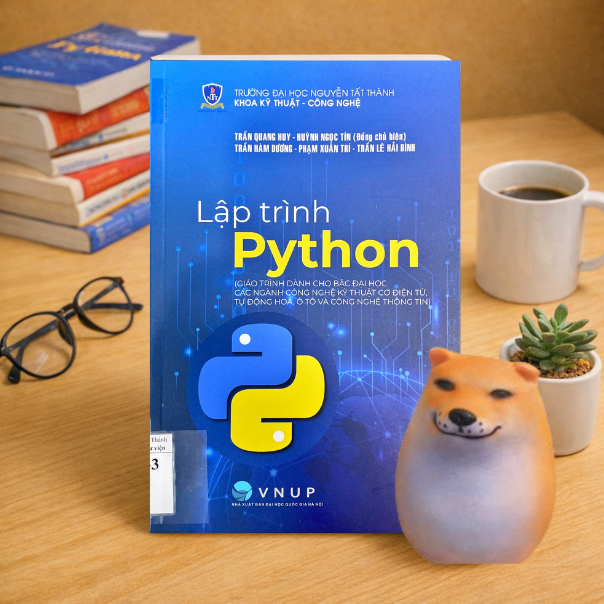
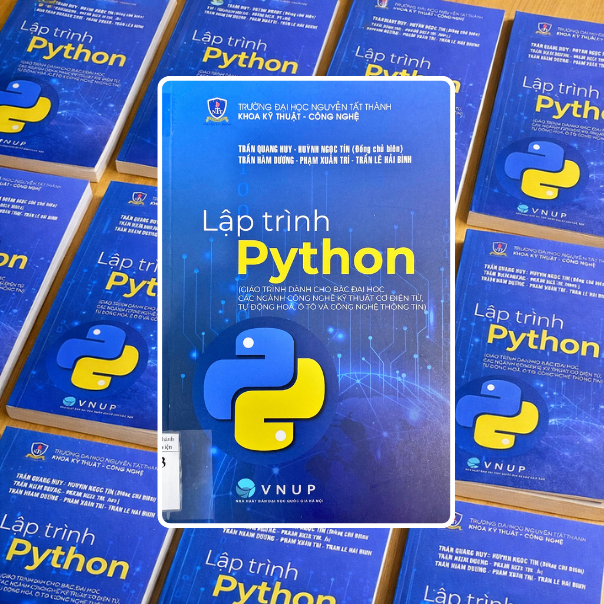
Book Introduction: Python Programming: A textbook for undergraduate students in mechatronics, automation, automotive, and information technology / Tran Quang Huy, Huynh Ngoc Tin (editors), Tran Ham Duong...
“Python Programming: A Textbook for Undergraduate Students in Mechatronics, Automation, Automotive, and Information Technology”
Editors: Tran Quang Huy, Huynh Ngoc Tin; and other authors Tran Ham Duong… Publisher
: Vietnam National University, Hanoi, 2025

With Python becoming one of the most popular programming languages in the world, especially in the fields of engineering, automation, data analysis, and artificial intelligence , the Python Programming textbook was created to meet the need for systematic programming training for technology and engineering students at the university level.
This book is compiled with an academic-practical-application orientation , making it suitable as the official material for basic Python programming courses in university programs.
🧩 Summary of key points
1. A systematic foundation in Python programming.
This course helps learners approach Python starting from the most basic concepts:
- Python syntax and program structure
- Data types, variables, operators
- Control structures (branches, loops)
- Functions and program organization
The clear and coherent presentation helps students develop sound programming thinking , avoiding a fragmented and unsystematic approach to learning Python.
2. Targeting engineering students – not purely IT students.
A key feature of the curriculum is that its content is designed to be suitable for students in the following fields:
- Mechatronics
- Automation
- Automotive technology
- Information technology
Python is not presented simply as a general programming language, but is placed within the context of solving engineering problems, control systems, simulations, and data processing , helping learners clearly see its practical applications.
3. Close integration of theory and practice
Each piece of content comes with the following:
- Example
- Practice exercises
- Application problem
This approach allows students to learn by doing , gradually developing programming skills, rather than just mastering theoretical knowledge.
4. Laying the foundation for advanced modules
The curriculum goes beyond simply teaching you "how to write Python code," and also includes:
- This prepares the foundation for subsequent subjects such as: control, simulation, data processing, AI, and IoT.
- It helps students become familiar with modern programming thinking, easily expandable to more advanced Python libraries and applications in the future.
🎯 Who should read this book?
The Python Programming book is particularly suitable for:
- University students in the following fields: mechatronics, automation, automotive, and information technology who are currently learning or preparing to learn Python programming.
- Engineering students who lack a programming background need a well-structured and accessible curriculum.
- Instructors and teaching assistants can use this as teaching material or reference for the Basic Python course.
- Python learners with a technical or industrial focus want to build a solid foundation before moving on to advanced applications.
- Self-taught individuals with a technical mindset who want to approach Python through an academic, university-standard learning path.
"Python Programming" is a standard, highly pedagogical textbook , meticulously compiled for undergraduate engineering programs. The book doesn't follow the trend of "quick learning - quick application," but focuses on helping learners understand the true nature of programming , develop logical thinking, and build long-term application skills.
_________________________________________________________
 The book is currently available at the NTTU Library: Lending Section Q12
 We cordially invite our esteemed readers to borrow and consult our materials.
#SachHayCanBanDoc #TodaySachVietNam #ThuvienNTTU #SachHayMoingay #NTTU