Book Introduction: Predictably Irrational: Exploring the Invisible Forces Behind Human Decisions / Dan Ariely; Translated by Hong Le and Phuong Lan
Predictably Irrational: Exploring the Invisible Forces Behind Human Decisions / Dan Ariely; Translated by Hong Le and Phuong Lan
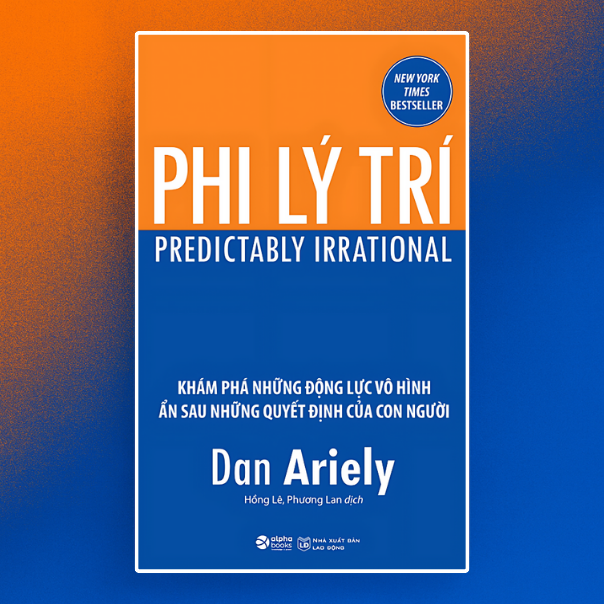
"Irrationality" by Dan Ariely is a landmark work in the field of behavioral economics—where psychology and economics intersect to decipher how people actually make decisions. The book shows that, contrary to the traditional assumption that humans always act rationally, many of our everyday decisions are actually irrational—yet predictable .
🧠 Key points and important information
"Irrationality" doesn't just present dry theories; through a series of experiments and surveys—including those in consumer and social environments—it exposes the "psychological illusions" we often fall prey to. Some notable concepts and effects include:
- The "free" effect : When an item is labeled "free," people are easily compelled to choose it—even if the item may not offer real value—because we fear "missing out."
- Relative comparisons instead of absolutes : Instead of evaluating each option at its absolute value, we often compare options—this causes decisions to be heavily influenced by context and presentation.
- The influence of expectations and beliefs on experience : We react not only to "raw" reality—but also to our prior expectations and beliefs. For example, if we believe that an item is "expensive = high quality," we may overestimate its quality.
- Inconsistency and irrationality in personal decision-making : From purchasing, consumption, and choices to decisions about health and time, we often don't behave like "rational humans" but are instead influenced by emotions, context, and psychology—which can repeat in patterns.
- The significance of "irrational" perception — for better decision-making : By understanding biases, prejudices, and psychological influences, we have the opportunity to reflect, consider, and avoid many mistakes in consumption, relationships, work, and more.
The entire book serves as an "eye-opening" revelation: many of our behaviors—even the smallest ones—don't stem from pure reason. But that doesn't mean "chaos"—because these behaviors are often predictable if we understand the psychological mechanisms behind them.
🎯 Who should read "Irrationality"?
This book is suitable for — and should be — a wide range of readers:
- For anyone curious about themselves and how they make decisions : If you've ever wondered why you make "irrational" choices—in shopping, work, relationships—this book will help you understand the inner workings.
- For marketing, sales, UX, and product design professionals : Understanding "irrational" mechanisms helps build better strategies — knowing how to design pricing, experiences, and messaging to align with real human psychology, rather than the assumption of "rational humans."
- Managers, leaders, marketers, and businesses who want to understand customers more deeply can apply this to understand consumer behavior, thereby designing more suitable products/services and strategies.
- Students, those studying economics, psychology, social sciences —or anyone interested in human behavior and decision-making—should broaden their understanding beyond the "just logic and self-interest" stereotype.
- Anyone who wants to improve their decision-making skills—in both personal and professional life : By understanding "psychological pitfalls," you can reflect on yourself, build habits, and make smarter decisions.
✅ Overall Review & Why You Should Read It
"Irrationality" is far from a dry book—it's vibrant, practical, accessible, and thought-provoking. It overturns the traditional notion that humans always act rationally—and replaces it with a more realistic, insightful look at the instincts, psychology, and context that influence each decision.
If you want to better understand how you, your friends, colleagues, customers—or society—behave and make decisions; want to avoid unconscious mistakes; want to build a smarter way of living, working, marketing, and doing business—then "Irrationality" is a book well worth reading.
_________________________________________________________
 Books are available at NTTU Library: Lending Warehouse Q12
 We invite readers to borrow and refer to the documents.
#SachHayCanBanDoc #NgaySachVietNam #ThuvienNTTU #SachHayMoiNgay #NTTU